Design ausstellen
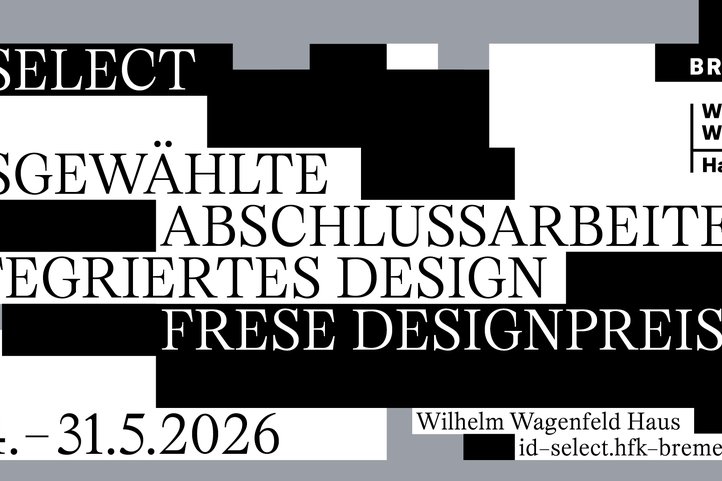
Der Frese-Design-Preis für eine herausragende Abschlußarbeit aus dem Integrierten Design an der HfK wird auch 2026 wieder vergeben.
Der Preis ist einer der bestdotierten Designpreise für Abschlußarbeiten an deutschen Hochschulen und wird gestiftet und vergeben von der Petra und Dieter Frese Stiftung in Bremen.
Die Auszeichnung soll dem oder der Verfasser:in der ausgewählten Arbeit einen guten Start in das Berufsleben oder einen neuen Studienabschnitt ermöglichen.
Für den Frese-Design-Preis konnten sich alle Abschlußarbeiten Bachlor und Master des letzten Jahres bewerben.
Aus der gesamtheit der Arbeiten ist eine Auswahl von 16 Arbeiten durch eine Jury erfolgt. Diese Arbeiten bilden die Ausstellung ID SELECT im Wilhelm-Wagenfeld-Haus (dem 'Designzentrum' Bremens) von 24.04.-31.05.2026
Die Aufgabe dieses Kurses ist die Fortsetzung und Umsetzung der Gestaltung der ID SELECT Ausstellung im Wagenfeld Haus:
Kommunikationsmittel, Ausstellungsgestaltung und Realisierung, Beleuchtung, Aussenwerbung sowie die Entwicklung eines rahmensprogramms und die Betrreuung der Veranstaltungen Eröffnung (23.04.26), Preisvergabe (05.05.26), Vortragsveranstaltungen, Lange nacht der Museen (30.05.26) sowie Finissage (31.05.26).
Der Kurs wird in Kooperation mit dem Wagenfeld Haus, der Frese Stiftung sowie dem HfK-Veranstaltungsmanagement und Referat für Öffentlichkeitsarbeit.
Der Kurs ist offen für alle interessierten Designstudierende, sowohl Bachlor wie auch Master.
Lerninhalte:
Was ist integriertes Ausstellungsdesign? Welche speizifischen Bedingungen sind zu berücksichtigen? Wie können die Arbeiten der HfK bestmöglich und ressourcenbewusst präsentiert werden? Welches Rahmenprogramm mit Führungen, Vorträgen und anderen Veranstalrtungen kann entwickelt und umgesetzt werden? Wie muss die Kommunikation gestaltet sein, um eine möglichst große Öffentlichkeit zu informieren und zu interessieren?
Es werden also eine ganze Menge fachpraktischer Fragen zur Anwednung kommen. Ein integriertes Projekt mit Realisierung bis zur fertigen Ausstellung.
Der Kurs knüpft nahtlos an die Ergebnisse des Entwurfskurses Design ausstellen aus dem WS 25/26 an, ist aber offen auch für alle interessierten neuen Teilnehmer!
Achtung: Start des Projektes in Block A ist bereits am Dienstag 24.03.26 um 11:00 in Raum 3.13.090
Weitere Termine jeweils Dienstags ab 10:00, sowie falls erforderlich weitere individuelle termine.
Prügfungsleistung: aktive Teilnahme, Realisierung
Lehrende: Prof. Detlef Rahe, Jonas Lang, Janina Ebner
sowie in Kooperation mit dem Kurs von Viktoria Dietz und Jakob Grommas (visuelle Gestaltung)
---
By examining diverse understandings of this keyword—from the legacies of colonial and early capitalist systems of governance to contemporary processes of financialization within the cultural field, as well as the subversive potential of engaging with infrastructures as sites of affect and contradiction—infrastructure emerges as both an invisible and visible force constituting culture today.
In contrast to cultural techniques, infrastructures aim at stability, yet they remain inherently dynamic, as they become perceptible only through use. They can be understood as formations whose apparent solidity depends on continuous processes of stabilization. Consequently, researching infrastructures requires conceptualizing them as processes of historical layering, rather than as fixed or permanent entities.
Infrastructures may also be approached as diagrammatic arrangements, encompassing technological and digital systems alongside social and care infrastructures. As noted, “we all live with infrastructures that, in most cases, are not our own—meaning we neither developed nor constructed them, nor did we have a say in their creation” (FKW 74).
Particularly relevant here are non-physical infrastructures—such as standards, protocols, and organizational frameworks—which shape behavior, structure usage, and document conventions and habits (Ahmed). These infrastructures operate through formats (e.g., DIN standards) and technical standards (such as USB or measurement systems) (Star, Griesemer, Schabacher), and they play a central role in object-oriented engineering (cf. Brusch).
Within the theoretical seminar, we will engage with these different dimensions of infrastructure by thinking with and through them, aiming to develop a process-oriented understanding of infrastructure as both condition and technique. We will discuss, read, write, and investigate, and the seminar will include excursions ( for example to DATA Center in Bremen and probably Weserwehr)
This seminar explores infrastructures through theory (reading and writing) as well as design and art practice.
This is a joint seminar by Jiawen Uffline, Prof Dr. Andrea Sick. and Prof. Dennis P Paul. It combines study modules DM.M-MD (Media Design / Special Topics in Digital Media) and DM.M-MT (Media Theory / Special Topics in Digital Media) into one project. Full participation is credited with 12CP in total. It is highly recommended to participate in both.
The joint seminar meetings will take place on Mondays between 10:00–18:00.
The seminar will be held in English.
Students from all departments (ID/FK/MUS/DM) are welcome. This includes DM Bachelor Students (Spezielle Gebiete MW), but please note that the seminar will be mainly held in english language.
Further information can be found at and will further evolve at http://dm-hb.de/infrastructures