The reality of the virtual
The 2023 Frese Design Prizes go to 3 graduates of the University of the Arts BremenA press release from Jens Fischer
An international jury has named 3 students of the University of the Arts Bremen (HfK Bremen) as winners of the Frese Design Prize: Hui Lin, Alexander Lehmann and Ana Rodríguez Heinlein. Jonghong Park, Anja Segermann and Farzad Golghasemi also received Frese Design commendations for their work.
All 6 award winners are graduates of the HfK study programmes ‘Integrated Design’ and ‘Digital Media’. Together with 24 fellow students, they are presenting their final projects at HfK Bremen’s Speicher XI A until 22 November 2023.
The Frese Design Prize has been awarded to young designers at HfK Bremen since 2014. It helps graduates of the Faculty of Art and Design to make their work visible nationally and internationally, supports their commitment to design and helps them start their careers.
The Frese Design Prize comes with prize money of 5,000 euros for first prize, 3,000 euros for second prize and 2,000 euros for third prize.
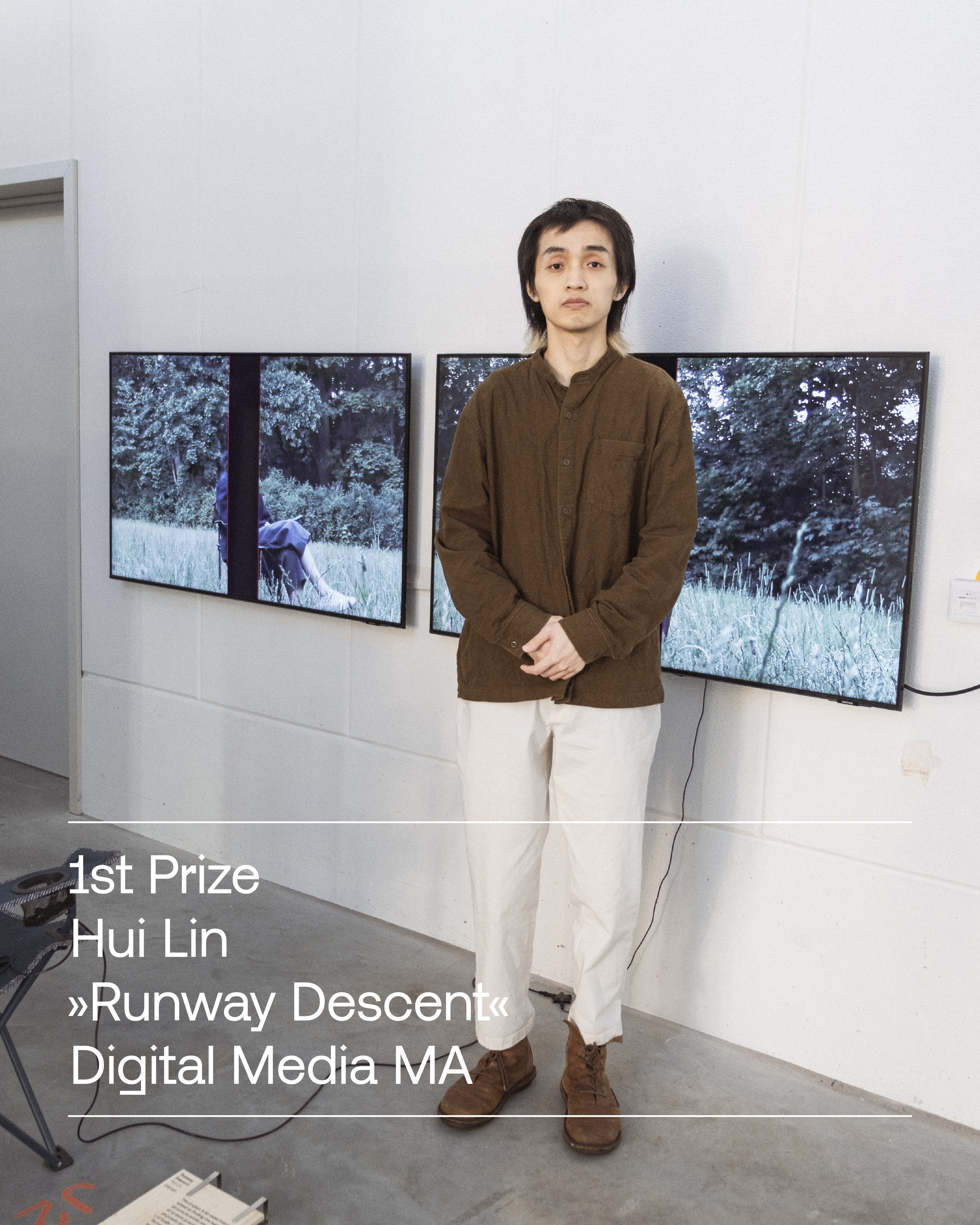
First place: Hui Lin (Master’s, Digital Media)
Title: ‘Runway Descent’, artistic medium: installation
Jury statement:
‘Runway Descent’ is a multi-layered installation that begins with a hyper-realistic CGI rendering and continues with a voice-over containing several audio and visual metaphors that convey the feeling of losing one’s senses between the real and the virtual world. This effect is heightened by the calm narrator’s voice, which shifts the timeline from the past to the present and into the future.
The degree of blurring between real and virtual images is well chosen and, thanks to the high quality of the footage, absolutely convincing. The shifting of boundaries is well executed by zooming out into the real exhibition space and by using a mirror effect that lets viewers experience this digital artwork as a medium of reflection, questioning our own existence.
Second place: Alexander Lehmann (Master’s, Digital Media)
Title: ‘Phase’, artistic medium: installation
Jury statement:
‘Phase’ is a very impressive immersive installation that intelligently combines sound, imagery, proportion and choice of materials. The installation as a whole is very coherent, with a precise scenography and structure that pays attention to the overall set-up right down to the smallest details, such as the aesthetic design of the circuit boards. The scale of the installation is used playfully and influences the viewers’ experience depending on whether they are closer to or further away from the artwork. ‘Phase’ draws many connections to art history and invokes famous references such as Malevich or László Moholy-Nagy. We see it as a contemporary interpretation of painters’ attempts to depict rhythmic compositions in visual patterns.
In our view, the work also refers to the development of media and musical instruments. One could draw an analogy between the sound produced by the motors that drive the movements and the sound of an organ. The moving fabrics recall the different sizes of organ pipes, but also the visual elements of a sequencer or even the pixels on a computer screen. The jury very much appreciated that the sound is generated by the installation itself, which adds to its synaesthetic qualities.
Third place: Ana Rodriguez Heinlein (Master’s, Integrated Design)
Title: ‘Tierra Sin Agua’, artistic medium: photography
Jury statement:
With her work ‘Tierra Sin Agua’, Ana Rodriguez Heinlein addresses a topical issue: water scarcity in the context of climate change. She engages intensively with the situation in Andalusia and the problems associated with it. The well-made photo series reflects the subject from her perspective: from the dryness of the landscape and high water consumption to dried-up rivers – but also cultural and traditional aspects of the region and the resulting problems for the local population. Alongside the focus on details, the documentary and analytical view of the situation was also convincing. Her unique and revealing observations and their thoughtful presentation impressed the jury on every level.
Special commendations go to Jonghong Park, Anja Segermann and Farzad Golghasemi.
Jonghong Park (Master’s, Digital Media): ‘Vague Boundaries’, installation
Jury statement: ‘Vague Boundaries’ is a powerful artwork in the sense that it is a machine that records itself and visually represents its own processes and movements. The installation creates a self-portrait of a physical phenomenon that also represents the actual scientific graph of the phenomenon – in this case a sine wave visualising the vibration or interference created by plucking a string. It draws a poetic line between the material world and its analytical representation, but also between the rigidity of the machine and the chaotic process at stake. ‘Vague Boundaries’ is a system capable of endlessly producing unique artworks, with potential for further explorations of colour and space, but also for future exhibition developments.
Anja Segermann (Master’s, Integrated Design): ‘Schichten’ (Layers), photography
Jury statement: Anja Segermann takes a fascinating look at our largest organ: the skin. In a tannery, she follows the processes involved in tanning cowhides. The multi-layered presentation combines photographs, a book and an image installation on the floor. The photographs impress with their exciting, high-contrast colours and let viewers ‘feel’ the materiality of the skin. We found the exhibition design coherent; the use of a wide range of materials underlines the engagement with the subject. Overall, we found it convincing how the student succeeds in taking a lively look at an extremely traditional craft in a technologised world.
Farzad Golghasemi (Master’s, Digital Media): ‘Endless Twist’, installation
Jury statement: ‘Endless Twist’, an interactive film installation, is a good example of a story that engages with the here and now. Starting from where we stand now, viewers are confronted with architecture, urban planning and a critique of capitalism, visualising the effects of standardisation and uniformity brought about by human-made software tools and algorithms.
To underline this neighbourhood context, the scenography is well chosen and executed with material borrowed from the local building site.
This year’s Frese Design Prize jury consisted of Marie du Chastel (freelance curator in Brussels, artistic director of the non-profit organisation KIKK), Simon Busse (industrial designer, owner of a design studio in Stuttgart) and Serge Rompza (graphic designer, design studio NODE Berlin Oslo). Anja Groten (designer, co-founder of the Hackers & Designers initiative, head of the design department at the Sandberg Instituut Amsterdam) was unable to attend due to illness.