Farewell to Professor Peter Bialobrzeski
After 19 years of teaching at the HfK: farewell to Professor Peter Bialobrzeski
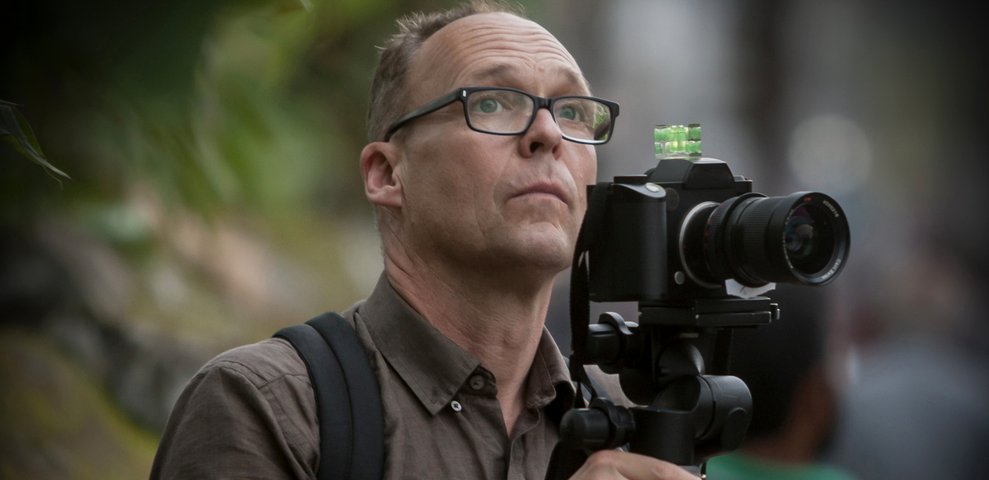
Peter Bialobrzeski, born in Wolfsburg in 1961, is one of the best-known and internationally most successful German photographers of our time. As a professor and author, he always sought a theoretical engagement with the medium of photography and set significant accents here. With his camera, he persistently describes and interprets the world. His works move within the borderland between documentary photography and artistic statement. According to the Deutschen Gesellschaft für Photographie (DGPh), complex bodies of work such as “Neontigers”, “Heimat” or “Lost in Transition” already rank among the modern classics of the medium.
After studying politics and sociology, Bialobrzeski initially worked in the 1980s as a local reporter and photojournalist in his home town of Wolfsburg. Even then, he undertook extensive travels through Asia, where, by his own account, he feels more at home than in Europe (see Bialobrzeski interview with Berlin Art Link). His fascination with Asia’s mega-cities is reflected in many of his works.
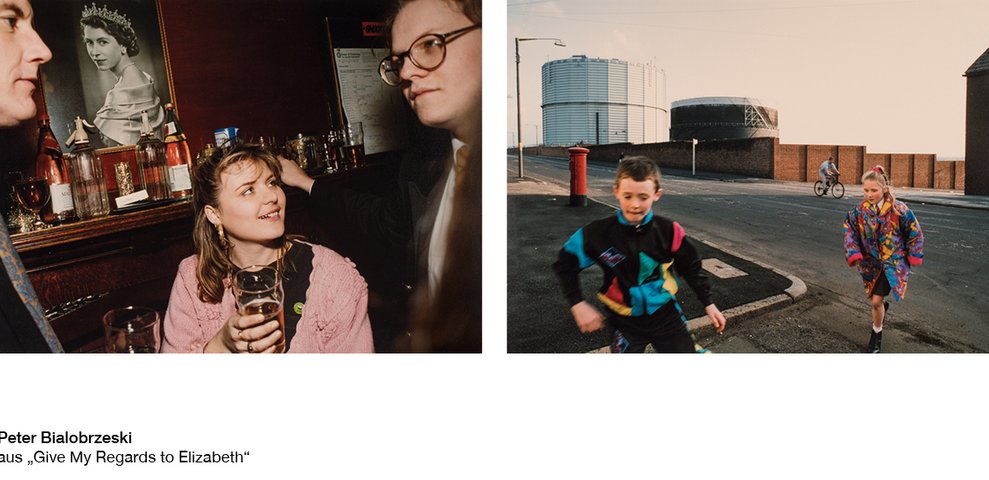
At the end of the 1980s came the decision to embark on artistic studies – at the Folkwang University of the Arts in Essen he began a degree in communication design with a focus on photography. From 1991 to 1992, Bialobrzeski went to London for a year of studies abroad to complete his degree at the London College of Communication. In his diploma project produced there, he set out to capture photographically the conditions in which the British were living at the time and the differences between the social classes. Bialobrzeski recently published these images in his photo book “Give My Regards to Elizabeth” (2020).
Peter Bialobrzeski as a guest on the podcast Nearest Truth
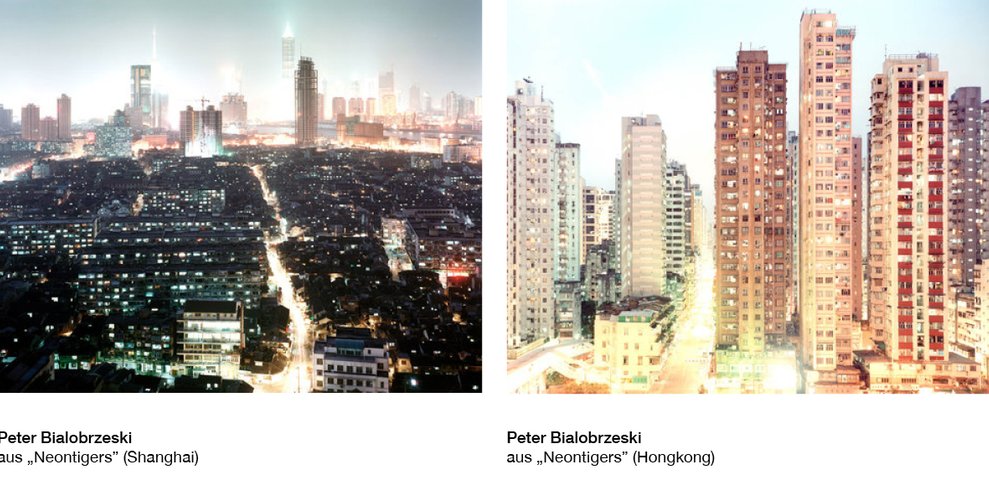
Since 1989, his photographic works have been published in renowned international magazines and periodicals such as Stern, Telegraph Magazine, ZEIT Magazin, the New York Times and GEO. Since 1994, he has been a member of the independent picture agency laif in Cologne. Alongside his journalistic work for magazines such as GEO, he increasingly turned to his own projects at the end of the 1990s and began to publish them in book form. His photo books and exhibitions have attracted great attention since the turn of the millennium. For “Neontigers”, his dazzling portrait of Asian megacities, he won the World Press Photo Award in 2003, thus achieving his international breakthrough.
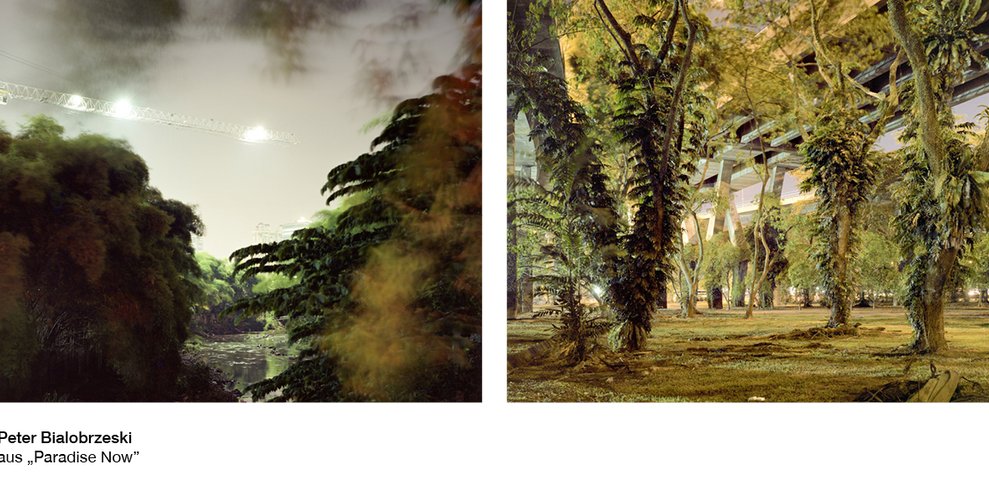
In 2010, Bialobrzeski won another World Press Photo Award for his work “Paradise Now”, created in Jakarta, Indonesia. His books have received multiple honours, including the “Deutscher Fotobuchpreis” (German Photo Book Award) and the “One of the Most Beautiful German Books” distinction. Bialobrzeski’s photographs have been shown in solo and group exhibitions on all five continents. The galleries Lothar Albrecht in Frankfurt am Main, Robert Morat in Hamburg and Laurence Miller in New York, as well as m97 in Shanghai, represent his large-format works on the international art market.
From the DGPh press release on the awarding of the Dr Erich Salomon Prize 2012:
“Peter Bialobrzeski lives in Hamburg and works around the world on his numerous projects, which centre on the globalisation of urbanisation. For him, social relevance is just as important as aesthetic seduction. His overwhelming visual discoveries of a rapidly changing world fascinate and disturb at the same time. The essayist Michael Glasmeier wrote of this: ‘Bialobrzeski works against speed. His deserted photographs show us precisely that state of an urban present between ruin and redefinition, between the not-yet-predetermined and the building site.’ And the critic Vicki Goldberg summed up in the New York Times: ‘Peter Bialobrzeski’s photographs give globalisation – and the invisible but powerful web that shapes our environment and, in a sense, determines our lives – a radiant, sophisticated face.’ Even if people are only rarely visible in his pictures, they are always what it is about: the way they live and how they change the world, or the world changes them. In doing so, the photographer rejects what he regards as an unfulfillable missionary promise and sees himself rather as an archivist in an era of constant change. He is interested in how today’s things will look as the past; he wants, in the truest sense of the word, to form his own picture, but to leave the interpretation to the viewer. Here he stands in the tradition of a Walker Evans, to whom he sees connections, or Bernd and Hilla Becher, from whom, however, he clearly distinguishes himself in his photographic splendour and artistic intention. Bialobrzeski rightly points out that the authenticity of photography can only ever be immanent to the image.”
Alongside his photographic work, Bialobrzeski also made a name for himself as a university teacher. After an interim professorship in “photojournalism” at the University of Essen from 1998 to 1999 and a further teaching assignment there, he was appointed Professor of Photography at the University of the Arts Bremen in 2002. In addition, he repeatedly complements his teaching with workshops in Germany and abroad.
As Professor of the Still Image at the HfK, he encouraged students to become independent creators of eloquent images. For Bialobrzeski, studying photography means not only learning to operate a camera professionally, but also knowing the history of photography and developing one’s own concepts from it. This presupposes an intensive engagement with the subject as well as precision. Peter Bialobrzeski significantly shaped the study of photography at the HfK with his aesthetic and initiated and accompanied numerous projects. On study trips to Minsk, Cairo, Norderney and Sarajevo, to name but a few, he helped students find their own photographic language and position. All in all, as a professor at the HfK he successfully prepared numerous young people for their professional lives in photography. This year (2021), Bialobrzeski is leaving the HfK. The exhibition at the Galerie Mitte will at the same time be a tribute to his time as a teacher.
PicDrop Podcast #024 – Peter Bialobrzeski – two-time World Press Photo Award winner (14 January 2020)
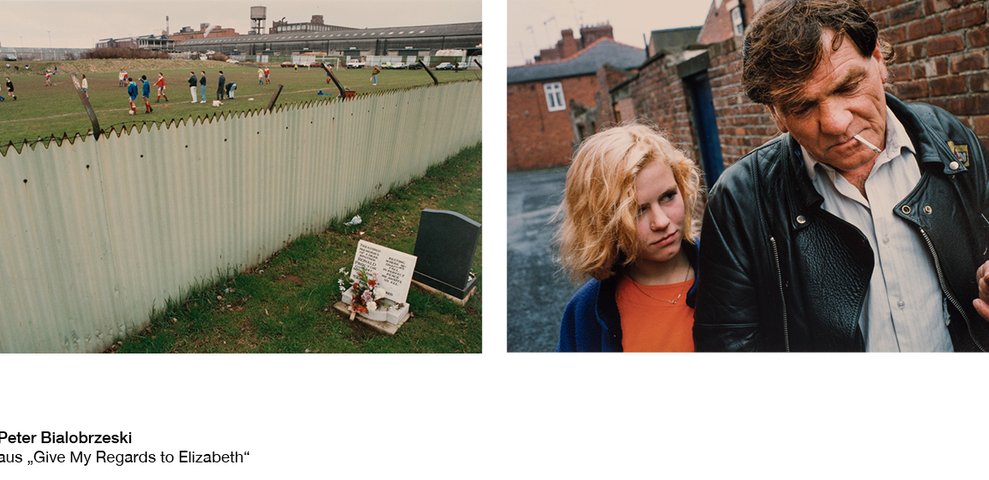
“Give My Regards to Elizabeth” – farewell exhibition at the Galerie Mitte
In the early 1990s, Peter Bialobrzeski spent a year at the London College of Communication, where, among other things, he photographed the series “Give My Regards to Elizabeth”. It was part of his graduation project at the Folkwang School – a one-of-a-kind piece in book form, analogue, with original photographs. In 2020, the work was also published in print by Hartmann Books – and the original prints are on display at the Galerie Mitte until 25 June 2021. On Tuesday, 22 June at 7 pm, Peter Bialobrzeski will be in an artist talk with the Weserburg curator Ingo Clauß.
Visits to the exhibition are possible by appointment! A maximum of five people from two households may be on site at the same time. On Tuesdays, between 10 am and 12 noon, Peter Bialobrzeski himself gives tours of the exhibition. Please register via: kontakt@galeriemitte.eu
To everyone’s regret, the exhibition opening on 31 March 2021 could only take place at a distance and in a private setting due to coronavirus restrictions. We therefore filmed it so that everyone can take part digitally. Speaking on behalf of the Galerie Mitte was Detlef Roth on behalf of Ele Hermel, followed by HfK Rector Roland Lambrette, Sandy Volz, a former student of Peter Bialobrzeski, and Andrea Rauschenbusch, Professor in the Masterstudio Kultur und Identität.
Farewell to Prof. Peter Bialobrzeski after 19 years of teaching
Video: Lukas Klose
The path to becoming an award-winning photographer: Peter Bialobrzeski
Peter Bialobrzeski is one of the best-known and internationally most successful German photographers of our time. As Professor of Photography at the University of the Arts Bremen (HfK), he significantly shaped the study of photography at the HfK with his aesthetic and initiated and accompanied numerous projects. After 19 years of teaching, Peter Bialobrzeski is now leaving the HfK. On the occasion of his farewell exhibition at the Galerie Mitte, the Weser Kurier reports on him and his time in Bremen.
To the article in the Weser Kurier, 31 March 2021, Simon Wilke
Exhibition tour with Peter Bialobrzeski
Give My Regards to Elizabeth
Excerpts from works
Peter Bialobrzeski gathered the materials for his works “Paradise Now”, “Case Study Homes” and “The Raw and the Cooked” during his research semester in 2007/2008. For “Paradise Now”, created in Jakarta, Indonesia, he won a World Press Photo Award in 2010.
Paradise Now
Case Study Homes
The Raw and the Cooked
Exhibitions, projects and publications at the HfK
In 2002, Peter Bialobrzeski was appointed Professor of Photography at the University of the Arts. He significantly shaped the study of photography at the HfK with his aesthetic and initiated and accompanied numerous projects. On study trips to Minsk, Cairo, Norderney and Sarajevo, to name but a few, he helped students find their own photographic language and position. He also led the HfK Masterstudio Kultur und Identität together with Prof. Andrea Rauschenbusch.
Masterstudio Culture and Identity
Image and text as cultural practice
In the HfK Masterstudio Culture and Identity, the dialogue between image and text forms the basis for the critical examination and development of aesthetic strategies of photography and visual communication. The studio’s experimental and research-based approach discusses and develops artistic strategies, aesthetic qualities and visual concepts that engage with forms of narration, communication and publishing – from the artist’s book to corporate communication.
Through overarching, also intercultural, problem settings, students experience themselves – in individual as well as team work – as self-determined designers and photographers who reflect on their abilities and attitudes in social, political and economic contexts and know how to contribute. In the interplay between conceptual, theoretical and practical work, independent research projects and case studies are to emerge.
You can find insights into current projects and works on the website of the Masterstudios Culture and Identity.
Minsk – photographs from Belarus: exhibition and publication
In 2018 still terra incognita for many Western Europeans, today on everyone’s lips due to current political events. Belarus is a country in which disregard for press freedom and human rights is omnipresent.
In April 2018, a group of students from the Masterstudio Culture and Identity of the University of the Arts Bremen travelled to the capital, Minsk, on an excursion led by Prof. Andrea Rauschenbusch and Prof. Peter Bialobrzeski, in order to form their own picture. A total of ten individual positions emerged – eight photographic and two image-text works – that engage with various realities of life in and around Minsk.
Some of the works already critically examined the political regime of the authoritarian and repressively governing ruler Lukashenko two years ago and, in view of the ongoing protests and strikes against the authoritarian head of state, are more topical than ever.
Minsk Минск Мінск engages with everyday life between traditional values and prevailing reality. The works were exhibited at the Galerie Mitte in 2019 and presented in the publication of the same name.
Calcutta, Chitpur Road Neighborhoods – The Kolkata Heritage Photo Project (2006)
In 19th-century Calcutta, under the rule of the British East India Company, an economically powerful Indian elite emerged that built the Bengali variant of the industrialist’s villa in an often eclectic-looking mix of styles between traditional Mughal architecture and Classicist elements. Today, the once magnificent villas and palaces are only a shadow of their former selves. It seems only a matter of time before the last stone witnesses of a once-glorious Bengali haute bourgeoisie disappear forever. 21 photography students from the University of the Arts Bremen, led by Peter Bialobrzeski, photographically documented the vanishing, crumbling splendour of this incomparable cultural heritage as the “Kolkata Heritage Photo Project”.
Fashion magazine AUS
Project in collaboration with Prof. Andrea Rauschenbusch and Prof. Ursula Zillig (2015)
Only those who are sure of themselves break AUS [‘out’] and find new paths. The magazine AUS of the University of the Arts Bremen takes a stance in the interplay of fashion and photography, philosophy and graphic design. AUS is about wilfulness and being outside – true to life, unsettling and familiar. AUS presents the works of young designers whose fashion was interpreted by photographers from a subjective perspective. It finds its counterpart in graphic design, meets Richard Buckminster Fuller or heads into the woods with Henry David Thoreau. Associations evoke new images. The material develops a life of its own, unfolds and becomes a medium. AUS is a dialogue between the disciplines.