MS Dauerwelle
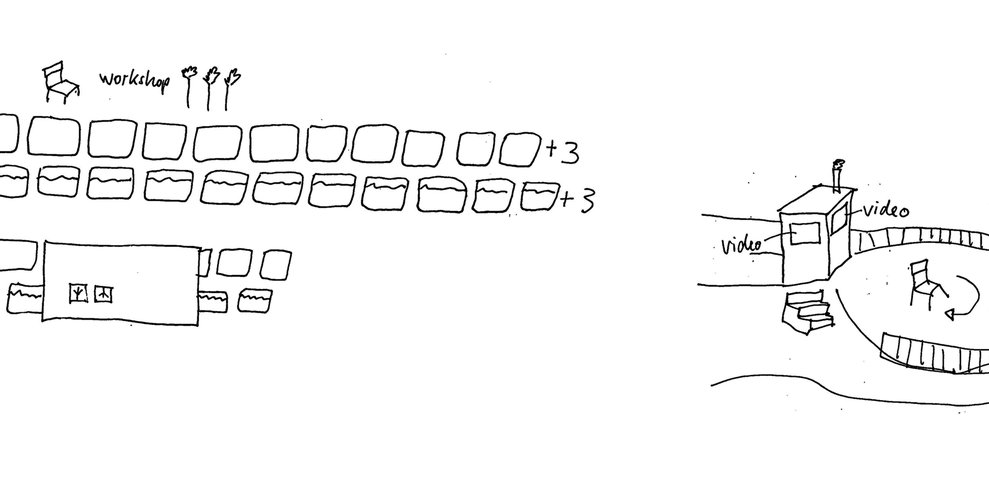
Dauerwelle. Traveling space for new modes of coming together with bodies and things.
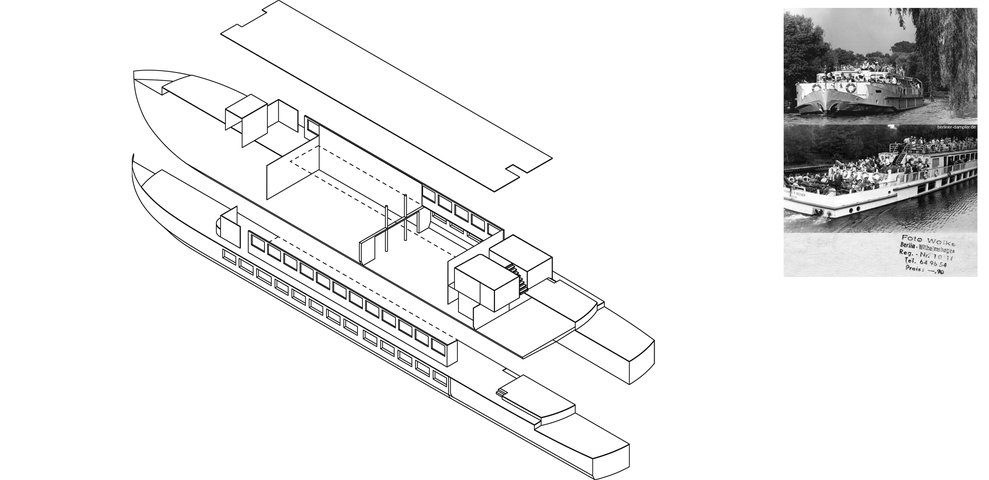
Since 2018, Asli Serbest, HfK Professor of Temporary Spaces, and Mona Mahall, Professor of Architecture and Art at HafenCity University Hamburg, have been working on the concept and design for transforming a passenger ship into a mobile space for the HfK’s exhibitions and events. Built in 1962 at the “Edgar André” shipyard in Magdeburg for up to 750 people, the 53-metre vessel belongs to the “Dichterklasse” (“Poets’ Class”), a series of eight inland vessels in the GDR that were named after writers. Back then, the “Dauerwelle” was called “Heinrich Mann”. From 2014, the ship operated in Gelsenkirchen under the name “Pirat”, hosting techno parties.
With the ship, Serbest/Mahall seek an active connection between the university and the city, as well as a place that enables diverse publics and operates across social, aesthetic and technological contexts. The ship project — which embodies their artistic practice of working with temporary, process-based spaces and which they are realising together with Peter Lilienthal — allows for activity and agility. As a floating, nomadic space without a fixed ground, the ship can travel the inland waterways from its permanent berth at the Bürgermeister-Smidt-Brücke, directly opposite the Weserburg Museum of Modern Art. Through subtractive interventions inside, it gains a hall in which various events and exhibitions can take place — in addition to its three open decks. The “Dauerwelle” can host projects by the HfK and other institutions and enable encounters as a political and aesthetic impulse.
Serbest/Mahall explain their concept as follows: “To think of a ship as an exhibition space in motion means imagining space actively: not so much as an art container that can be visited, but rather as an act of visiting itself. The ship reaches different places as a guest or intruder, as a temporary neighbour in urban or rural, in dense or rather scattered areas. It questions static institutional thinking, fixed spatial conditions and organisational structures, as well as the idea of an unchanging public.
Insofar as the nomadic is embraced as an alternative to settled, rational thinking, the ship too can open up other forms of exhibiting and discourse. It can help forge diverse contacts and calls for new collective processes and different ways of making and perceiving things. Above all, the ship will enable new forms of coming together.”
According to Serbest/Mahall, the “Dauerwelle” can be understood as a late response to the utopian projects of radical architecture of the 1960s and 1970s – such as the “Walking City” or “Nonstop City” designs by the artist groups Archigram (UK) and Archizoom Associati (Italy). They had conceived spaces, architectures and even cities that were not tied to fixed locations but were to be set in constant motion. “It is movement, not the grand (masculine) utopia, that is of interest for the ship, which has already been in service for 60 years. At the same time, it points to a series of historical and active relationships: relationships of power and exploitation, but also of desire and imagination; in Bremen, colonial history with a colonial present; in Europe, tourist excursions with flight. Dauerwelle is an agent that can connect and confront things, living beings and ideas,” say Serbest/Mahall.
Cast off – the journey of the “Dauerwelle”
Here you can see the various (travel) stages of the HfK ship “Dauerwelle” on its way to taking up its permanent berth in Bremen.
Asli Serbest, Mona Mahall and Peter Lilienthal, head of building management and facilities at the HfK, set off for Gelsenkirchen to complete the handover of the ship. They departed from Grimberg on Monday, 9 November 2020, at around 12 noon, travelling along the Rhine-Herne Canal via Oberhausen-Dorsten to the Flaesheim lock. The destination of the transfer is the Kötter shipyard in Haren, where the ship will be overhauled and the first conversion work will take place.
The handover of the ship and any final technical details and questions can be settled: Peter Lilienthal, the all-rounder in all matters of ship organisation and handover, with the previous owner Guido Krohmann aboard the “Dauerwelle”.
The “Dauerwelle” is in dry dock at the Kötter shipyard in Haren and is being prepared for the conversion work.
The ship is being renovated to make mobile spatial and exhibition concepts possible.
The “Dauerwelle”’s tween deck is being cut out. Excavation and welding work thus create room for the flexible exhibition space.
The “Dauerwelle” is now 60 tonnes of steel lighter. So that its structural stability is maintained, 14 tonnes of gravel now fill the hull as ballast.
The ship lies at the Lankenauer Höft, almost exactly opposite the university on the other side of the Weser. Final work is being carried out there.
At the end of January, the “Dauerwelle” arrives at its permanent berth at the Bürgermeister-Smidt-Brücke, directly opposite the Weserburg Museum of Modern Art.
A coot has moved in as the “Dauerwelle”’s first resident.
Welcome aboard!
The time has finally come: on Saturday, 22 January 2022, the “Dauerwelle” took up its first berth in Bremen at the Bürgermeister-Smidt-Brücke.
Photos: Lukas Klose & Pia Winter
Video: Lukas Klose
Photos: Lukas Klose
After three years of design and planning, however, the transformation of the former passenger ship into a mobile space for the HfK has only just begun. Now students and teaching staff can use the ship and, through change and movement both inside and out, enable new active connections between the university, the city and the region.
Events on the “Dauerwelle”
Diploma exhibitions 2022
The programme begins with a diploma exhibition by Fine Art students Ole Prietz and Behshad Tejammol. Three open decks and a hall are available to them. The show opens internally at the HfK on 3 February and can be visited on 4, 5 and 6 February 2022.
Photos: Ana Rodríguez
Workshop: Body Dance Protest, the way things go, the ship as a resonating body
At the end of the lecture period in the winter semester, the Dauerwelle could be used for a workshop with a range of students and tried out in various ways.
The students from Fine Art, Integrated Design, Digital Media and Music explored dance and bodily practices of protest and asked about possible forms of political stance in which ‘the way things go’ can be interrupted and questioned. The Dauerwelle itself was understood as a resonating body. From sound recordings made at the railing, in the interior, on the window surfaces and on the hull, smaller compositions were developed, to which the students created performances, gestures and small choreographies. Fabrics and materials from a working process on the figure of the fool as a political figure and on the ship of fools, developed by Daniel Mohr as part of his preparations for his master’s degree in fashion, formed an inspiring second space within the workshop.
The Dauerwelle is a light-flooded, very special place and contributed to a wonderful, respectful, intimate working atmosphere.
Participants: Ruby-Marie Lohse, Berna Esra Ayzit, Alina Denzin, Benjamin Schlemmer, Vera Deubner, Jiale Wei, Reika Hattori, Lina Brockop, Noura Assayed, Celine Nastasia Schesnik, Leonie Iwohn, Malte Servaty, Daniel Mohr, Carola Mittelstraß, Hanna Everding, Berit Riekemann, Leon Berger, Jule Denzin, Thi Laura Mai Nguyen Chi, Raphael Sbrzesny and others.
Photos: Raphael Sbrezsny
NARRETEI – MA graduation project by Daniel Mohr
Daniel Mohr, master’s student in the Integrated Design programme, writes:
“NARRETEI” is the name of my fashion master’s graduation project at the University of the Arts Bremen, 2022. In my thesis I engage with the sacred figure of the fool, which developed from the Native American trickster, was shaped and demonised by the Catholic Church in the 15th century, and later lives on in carnival festivities, in the clown, in the punk movement of the late 1970s and, in the future, in cyberpunk. Where does the fool come from? Why did its character take on a negative connotation? Where are fools still to be found today, and will folly have a future?
Exhibition: FEAR. In Russia: in jails, in Ukraine: dying.
Expressionistically furrowed faces, painted with impasto, stare into the void. Or linger in fear-saturated timidity. Warn of disaster like death masks. Fade away behind bars. Express hardship and suffering and seem almost to burst with horror. Anastasiia Guzenkova’s paintings are so inconceivably real, so radically removed. The pictures glow a glaring red, enveloped in impenetrable darkness that stands for the loss of clarity and control, for the unknown, the threatening. For the night sides of reality, of life. The abyss of civilisation, or its edge, where it dissolves into barbarism. War.
The artist was born and raised in Moscow, is 24 years old and is in her sixth semester of Fine Art with Heike Kati Barath, Professor of Figurative Painting at the University of the Arts (HfK) Bremen.
The two-part exhibition featuring more than 20 works can be seen from 19 to 26 March 2022, daily from 2 to 7 pm.
Photos: Lukas Klose
Group exhibition – OUR POROUS LIMITS II
Group exhibition on the HfK Bremen’s Dauerwelle, curated by Wendelin van Oldenborgh, from 14 to 24 April 2022.
Participating artists:
Maria Arzt, Miyeon Chung, Tabea Erhart, Ruoxian Fu, Carlotta Haebler, Dohee Kim, Elizaveta Kovalenko, Hyunbok Lee, Angela Lieber, Jiwoo Park, Jana Piotrowski, Vicc Repasi, Victor Artiga Rodriguez, Liudmila Savelyava, Renen Itzhaki Solstice, Abdulghaffar Tammaa, Yuliya Tsviatkova, Jonad Yipeung
OUR POROUS LIMITS is the second exhibition to have grown out of a way of working based on shared exchange that emerged in winter 2020 and previously, during the lockdown and pandemic restrictions of the past year, culminated in a first exhibition at the Spedition. Almost exactly a year later, we are all the more delighted to be able to invite you to our next exhibition, which follows the same logic and this time is open to visitors.
Interest has grown in strengthening the connections between the diverse and multifaceted practices of the participating artists. In the form of a ‘chain of response’, in which the artists have each reacted to one another’s works, there is an intensive exchange among them. This practice also forms a supporting and load-bearing structure that guides visitors through the anatomy of the exhibition. It is the collective that carries the exhibition, while acknowledging and strengthening the individual positions. At the same time, in perceiving the overlaps between the individual interests, a collective strength becomes apparent.
Photos: Ana Rodríguez
First exhibition of the binational Artistic PhD programme at the University of the Arts Bremen
Halbe Halbe – Floating in, Swerving out, Doing Art and Theory, 14–19 June
On 14 June, the individual projects of the exhibition were presented in lecture performances from 6 to 8 pm at the premises of the Gesellschaft für Aktuelle Kunst (GAK) Bremen. At 8:30 pm, the opening of the exhibition “Halbe Halbe” then began aboard the HfK ship “Dauerwelle”, which could be visited from 14 to 19 June. With the exhibition, the HfK also took part in the Lange Nacht der Museen (Long Night of Museums) on 18 June.
“The PhD candidates have devoted themselves to projects and research activities that go beyond classical disciplinary boundaries,” says Prof. Dr Andrea Sick, Vice-Rector for Artistic Research and International Affairs at the University of the Arts. “This is also reflected in the name of the event. ‘Halbe Halbe’ [‘fifty-fifty’] illustrates that no separation exists between art and theory in the exhibition, nor in the practice of those exhibiting,” says Prof. Dr Sick. “But of course the title also expresses a certain irony, an ironic self-reference, relating to the impossibility of the demand to maintain such a strict division into art and theory across all areas and to always already keep it in mind in one’s work. A precisely calculable and measurable interrelationship simply cannot be accounted for,” Prof. Dr Sick emphasises.
Photos: Jimmy Lui
Naming ceremony of the “Dauerwelle”
The ship’s naming ceremony took place on 4 May 2022 at 6 pm at the berth on the Bürgermeister-Smidt-Brücke – opposite the Weserburg.
The 53-metre ship had already taken up its berth in the centre of Bremen in January 2022. Now the official naming ceremony followed, held in a festive setting. Alongside speeches by Professor Roland Lambrette, Rector of the HfK, and Dr Antje Stephan, Chancellor of the HfK, Kay Wenzel, representative of the Senator for Science and Ports in Bremen, also gave an address.
Asli Serbest, Professor of Temporary Structures, has played a major role in shaping the Dauerwelle project together with Mona Mahall, Professor of Architecture and Art at HafenCity University Hamburg. Professor Serbest gave insights into the history and the concept of the “Dauerwelle”. Ingo Vetter, Professor of Sculpture with Classical Materials and Dean at the HfK, spoke about the significance of the “Dauerwelle” for the HfK but also for Bremen.
The naming ceremony was hosted by Peter Lilienthal, technical director of the HfK. Lilienthal was co-responsible for the conversion of the “Dauerwelle” and accompanied it with great dedication.
The programme was rounded off with music, performances, video projections and a sound installation by HfK students.
Photos: Lukas Klose
The naming ceremony
Video: Lukas Klose
A short tour around the “Dauerwelle”
Video: Lukas Klose
The “Dauerwelle” in the press
- PRESS: Bremen bekommt eine "Dauerwelle" – Weser-Kurier, 21 January 2022
- VIDEO: HfK stellt Ausstellungsschiff vor (from 01:30) – Source: Buten un Binnen Regionalmagazin, 22 January 2022
- PRESS: Bremen bekommt schwimmende "Dauerwelle" – Source: Kreiszeitung, 24 January 2022
- PRESS: Dauerwelle als schwimmendes Ausstellungsschiff – Source: Nordwest Zeitung, 28 January 2022
- VIDEO: Hochschule für Künste in Bremen ruft einzigartiges Kunst-Projekt ins Leben – Source: 17:30 | SAT.1 Regional, 4 February 2022
- VIDEO: Ausstellung der Hochschule für Künste (from 00:35) – Source: Buten un Binnen Regionalmagazin, 5 February 2022
- WEBSITE: Bremen, was geht? Aktuelle Ausstellungen in Museen und Galerien – Source: gallerytalk.net, 1 March 2022
- INTERVIEW: So protestiert eine russische Künstlerin in Bremen gegen Ukraine-Krieg – Source: Buten un Binnen Regionalmagazin, 19 March 2022
- PRESS: Schwimmende Kunst – Source: Wirtschaftsförderung Bremen, 15 July 2022