Kunst und Design
Icaro López De Mesa Moyano
Spezielle Gebiete, Media Design
- Study programme Digitale Medien
- Email ilopezdemesamoyano@hfk-bremen.de
Current courses
- The multicultural condition that enables the exchange of knowledge from different regions of the world, when they encounter each other and coexist, reveals contradictions when a culture perceived as foreign, begins to be seen as the Other. Otherness can be identified, for example, when the impossibility of fully understanding what the Others represent, leads us to simplify them or to distance ourselves from them. Elasticity, on the other hand, a physical and material capacity, when understood as a concept, implies adaptability and the ability to respond flexibly to opposing forces. It can thus be applied to human and social capacities to adapt to tensions, to stretch and resist external forces, and to return to an original form transformed. Much like elastic materials do but in this context, like migrants do, like the Other does. An elastic perspective on otherness therefore offers the possibility of gaining perspective on the Other moving closer and farther away, not in order to fully understand it, but to relate to them in balance, while acknowledging the tensions of difference. Through theoretical resources such as readings and practical exercises in writing and performance, as well as work with materials and tools for creation and for designing critical instruments, this course will serve as a space to sensitize the gaze of artist and designers towards contemporary sociopolitical phenomena. These phenomena are made visible by increasing global migration (between nations or from peripheries to centers), driven by the asymmetric encounter between the dominant Western (and/or Global North) modes of articulating reality and the multiple collectivities that constitute its otherness. ____________________________________________________________________ Trigger Questions: Liberal Multiculturalism What is multiculturalism? What makes us multicultural? How does multiculturalism influence design practices? What characterizes the liberal/Western form of multiculturalism? Otherness How universal is otherness? Are we all the Other? Are there hegemonies that determine the other, or from where is that otherness configured? Does design produce or reproduce otherness? Elasticity What elastic behaviors emerge in migrant communities as they inhabit foreign contexts while preserving their culture and idiosyncrasies? What mechanisms of resistance can be identified in internationalized cities (or those open to multiculturalism) in the face of capitalist tensions or imposed forms of social interaction? How can the design of fictional devices make these elastic or resistant behaviors visible? Design Fictions What are the possible fictions in this multicultural elastic context? ____________________________________________________________________ Course Objectives General Objective To provide disciplinary tools that clarify the historical, epistemic, and political situatedness of artists and designers, assuming them as active agents in relational practices in which intersecting asymmetries are often overlooked. Based on these theoretical and practical exercises, participants will collectively prototype devices situated at the intersection of speculative media design, fiction, and performance. Specific Objectives Observe, document, and synthesize: Mapping and Cartography To observe, document, and synthesize existing realities in order to understand what characterizes the emergence of an elastic otherness and to propose design scenarios that make visible problematic layers of multiculturalism. Adapt, exchange, relate To engage with other academic and social contexts in the development of a design project, and to generate spaces of encounter that promote critical thinking through art, media and design. Fictionalize, materialize, perform To propose fictional scenarios that invite reflection and rethinking of environments through the exploration of spaces and materials. ____________________________________________________________________ Methodology The course will be conducted in a collaboration between masters students and professors from the faculty of architecture and design from la Universidad de los Andes (Colombia) and master students and professors from Kunst und Desing from the Hochschule für Künte HfK Bremen (Germany). Participants from both institutions will exchange to develop social cartographies and document migratory ecosystems as tools to analyze disobedient, elastic, and resistant behaviors within communities. The course will explore how politically incorrect approaches can release tensions and contradictions inherent in multiculturalism, experimenting with performative theater tools such as stage costumes, explorations with elastic materials/objects, textiles, written and spoken text, sound, body movement, and digital media. Through a series of workshops during the first week, the course will include both a theoretical component and an applied research component, developed simultaneously. Theory will be combined with practical exercises, culminating in a final presentation of prototypes of/and performative devices located at the intersection of speculative design, art, media and performance. Theoretical Component: Dialogues, interviews and conceptual discussions. Applied Research: Research through making: as phenomena are analyzed, they take on practical and material form. Creation of design fictions presented through performance: Design fictions are diegetic devices used to generate experiences for audiences that allow them to conceive a problematic situation as plausible, with the aim of triggering questions about that situation or about their own perception of reality. These fictions are usually audiovisual products circulated digitally; however, for the purposes of this course, we aim to explore the intersection between design fiction and performance as the central outcome. ____________________________________________________________________ Bibliography ? Glissant, É. (1997). Poetics of relation (B. Wing, Trans.). University of Michigan Press. (Original work published 1990) ? Guattari, F., Rolnik, S. (2008). Molecular revolution in Brazil. Semiotext(e). ? Malabou, C. (2005). The future of Hegel: Plasticity, temporality and dialectic (L. During, Trans.). Routledge. (Original work published 1996) ? Maharaj, S. (2009). Perfidious fidelity: The untranslatability of the other. In A. Papastergiadis (Ed.), Complex entanglements: Art, globalization and cultural difference (pp. xx–xx). Rivers Oram Press. (Ajustar páginas si se requieren) ? Pater, R. (2019). Caps lock: How capitalism took hold of graphic design, and how to escape from it. Valiz. ? Rolnik, S. (2006). Cartografías del deseo. Tinta Limón. (Si el texto corresponde específicamente a “Políticas del fluido híbrido y flexible…”, puede citarse como capítulo) ? Rolnik, S. (2018). Políticas del fluido híbrido y flexible para evitar falsos problemas. s. l.: s. n. ? Žižek, S. (1997). Multiculturalism, or, the cultural logic of multinational capitalism. New Left Review, 225, 28–51. ? Silvia Rivera Cusicanqui – Un mundo Ch’ixi es posible: Ensayos de un presente en crisis --- The multicultural condition that enables the exchange of knowledge from different regions of the world, when they encounter each other and coexist, reveals contradictions when a culture perceived as foreign, begins to be seen as the Other. Otherness can be identified, for example, when the impossibility of fully understanding what the Others represent, leads us to simplify them or to distance ourselves from them. Elasticity, on the other hand, a physical and material capacity, when understood as a concept, implies adaptability and the ability to respond flexibly to opposing forces. It can thus be applied to human and social capacities to adapt to tensions, to stretch and resist external forces, and to return to an original form transformed. Much like elastic materials do but in this context, like migrants do, like the Other does. An elastic perspective on otherness therefore offers the possibility of gaining perspective on the Other moving closer and farther away, not in order to fully understand it, but to relate to them in balance, while acknowledging the tensions of difference. Through theoretical resources such as readings and practical exercises in writing and performance, as well as work with materials and tools for creation and for designing critical instruments, this course will serve as a space to sensitize the gaze of artist and designers towards contemporary sociopolitical phenomena. These phenomena are made visible by increasing global migration (between nations or from peripheries to centers), driven by the asymmetric encounter between the dominant Western (and/or Global North) modes of articulating reality and the multiple collectivities that constitute its otherness. ____________________________________________________________________ Trigger Questions: Liberal Multiculturalism What is multiculturalism? What makes us multicultural? How does multiculturalism influence design practices? What characterizes the liberal/Western form of multiculturalism? Otherness How universal is otherness? Are we all the Other? Are there hegemonies that determine the other, or from where is that otherness configured? Does design produce or reproduce otherness? Elasticity What elastic behaviors emerge in migrant communities as they inhabit foreign contexts while preserving their culture and idiosyncrasies? What mechanisms of resistance can be identified in internationalized cities (or those open to multiculturalism) in the face of capitalist tensions or imposed forms of social interaction? How can the design of fictional devices make these elastic or resistant behaviors visible? Design Fictions What are the possible fictions in this multicultural elastic context? ____________________________________________________________________ Course Objectives General Objective To provide disciplinary tools that clarify the historical, epistemic, and political situatedness of artists and designers, assuming them as active agents in relational practices in which intersecting asymmetries are often overlooked. Based on these theoretical and practical exercises, participants will collectively prototype devices situated at the intersection of speculative media design, fiction, and performance. Specific Objectives Observe, document, and synthesize: Mapping and Cartography To observe, document, and synthesize existing realities in order to understand what characterizes the emergence of an elastic otherness and to propose design scenarios that make visible problematic layers of multiculturalism. Adapt, exchange, relate To engage with other academic and social contexts in the development of a design project, and to generate spaces of encounter that promote critical thinking through art, media and design. Fictionalize, materialize, perform To propose fictional scenarios that invite reflection and rethinking of environments through the exploration of spaces and materials. ____________________________________________________________________ Methodology The course will be conducted in a collaboration between masters students and professors from the faculty of architecture and design from la Universidad de los Andes (Colombia) and master students and professors from Kunst und Desing from the Hochschule für Künte HfK Bremen (Germany). Participants from both institutions will exchange to develop social cartographies and document migratory ecosystems as tools to analyze disobedient, elastic, and resistant behaviors within communities. The course will explore how politically incorrect approaches can release tensions and contradictions inherent in multiculturalism, experimenting with performative theater tools such as stage costumes, explorations with elastic materials/objects, textiles, written and spoken text, sound, body movement, and digital media. Through a series of workshops during the first week, the course will include both a theoretical component and an applied research component, developed simultaneously. Theory will be combined with practical exercises, culminating in a final presentation of prototypes of/and performative devices located at the intersection of speculative design, art, media and performance. Theoretical Component: Dialogues, interviews and conceptual discussions. Applied Research: Research through making: as phenomena are analyzed, they take on practical and material form. Creation of design fictions presented through performance: Design fictions are diegetic devices used to generate experiences for audiences that allow them to conceive a problematic situation as plausible, with the aim of triggering questions about that situation or about their own perception of reality. These fictions are usually audiovisual products circulated digitally; however, for the purposes of this course, we aim to explore the intersection between design fiction and performance as the central outcome. ____________________________________________________________________ Bibliography ? Glissant, É. (1997). Poetics of relation (B. Wing, Trans.). University of Michigan Press. (Original work published 1990) ? Guattari, F., Rolnik, S. (2008). Molecular revolution in Brazil. Semiotext(e). ? Malabou, C. (2005). The future of Hegel: Plasticity, temporality and dialectic (L. During, Trans.). Routledge. (Original work published 1996) ? Maharaj, S. (2009). Perfidious fidelity: The untranslatability of the other. In A. Papastergiadis (Ed.), Complex entanglements: Art, globalization and cultural difference (pp. xx–xx). Rivers Oram Press. (Ajustar páginas si se requieren) ? Pater, R. (2019). Caps lock: How capitalism took hold of graphic design, and how to escape from it. Valiz. ? Rolnik, S. (2006). Cartografías del deseo. Tinta Limón. (Si el texto corresponde específicamente a “Políticas del fluido híbrido y flexible…”, puede citarse como capítulo) ? Rolnik, S. (2018). Políticas del fluido híbrido y flexible para evitar falsos problemas. s. l.: s. n. ? Žižek, S. (1997). Multiculturalism, or, the cultural logic of multinational capitalism. New Left Review, 225, 28–51. ? Silvia Rivera Cusicanqui – Un mundo Ch’ixi es posible: Ensayos de un presente en crisis
News
Events
- 24 – 26 October 2024 6 p.m.
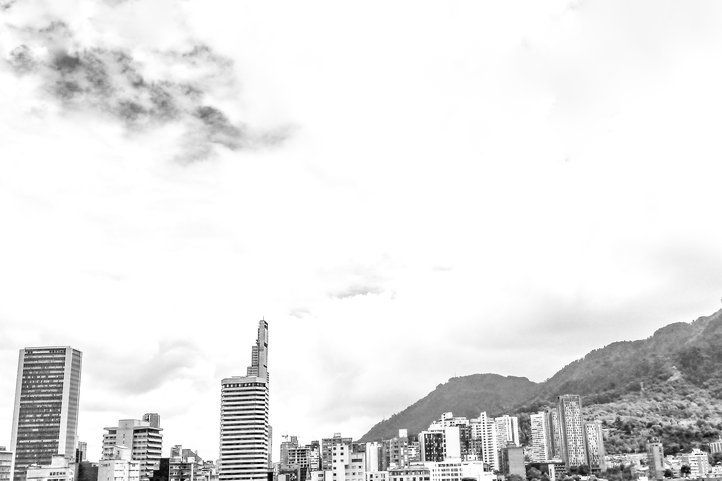 Talk, Symposium24 – 26 October 2024 6 p.m.
Experimentalism, Music, and Aurality: Bogotá as a place of listening
University of the Arts Bremen | Gallery (0.05)Past events - 12 – 14 September 2024 6 p.m.
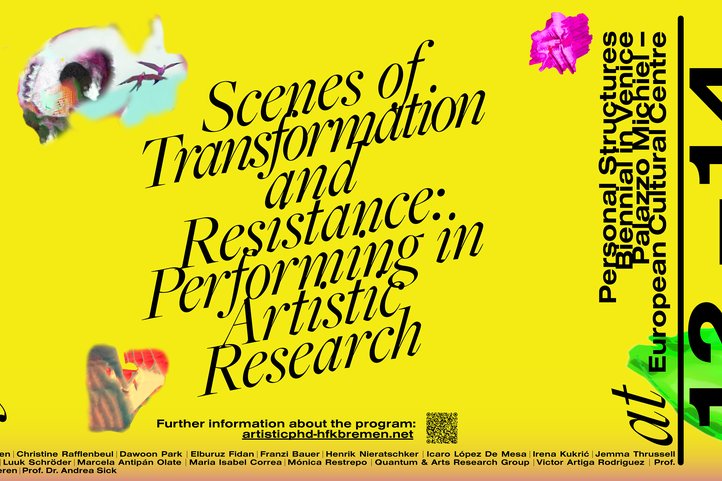 Talk, Symposium12 – 14 September 2024 6 p.m.
Summer school: Scenes of Transformation and Resistance: Performing in Artistic Research
Congress Hall at Palazzo MichielPast events - 5 – 6 April 2024 10 a.m.
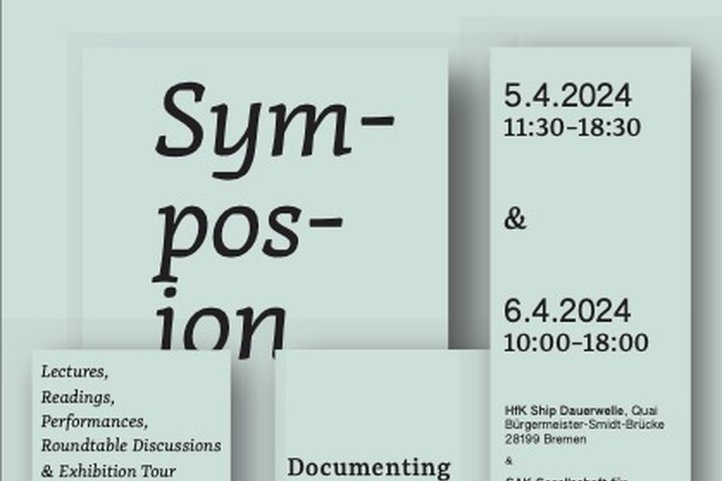 Symposium5 – 6 April 2024 10 a.m.
Documenting in Artistic Research
MS DauerwellePast events


